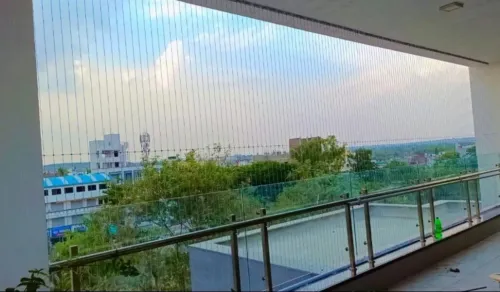

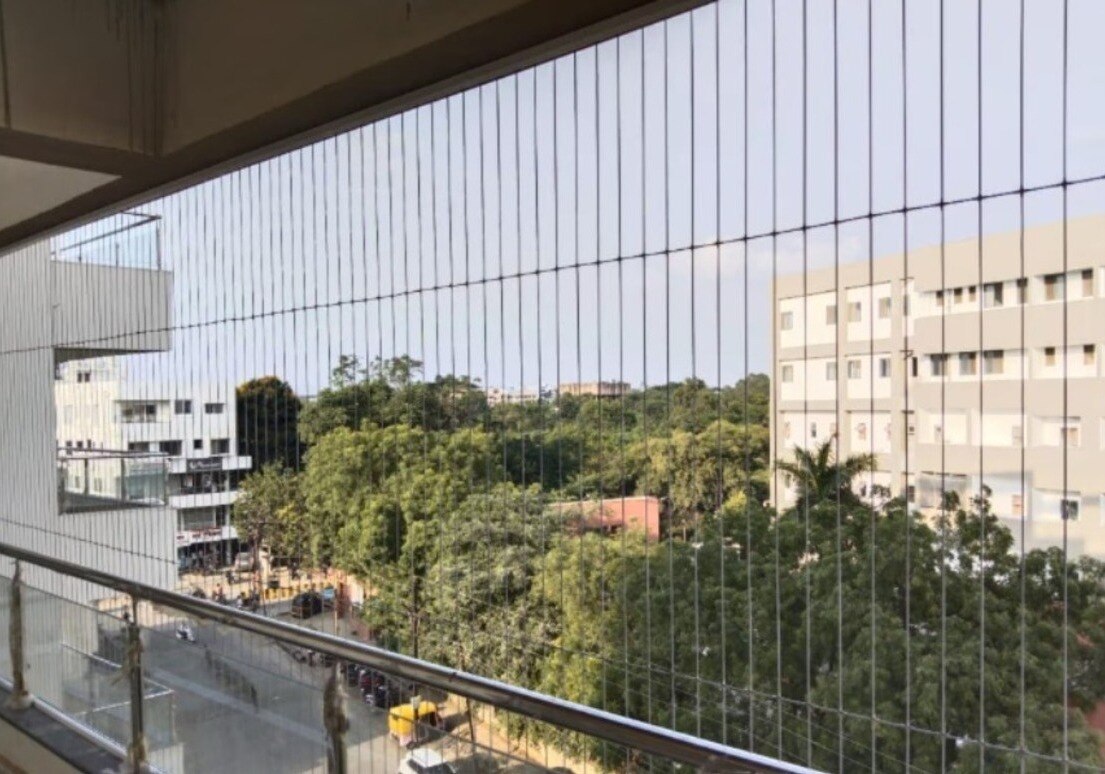
A tensioned wire system is only as safe as its spacing, anchors, layout and access controls. Before approving work, you will be able to measure the actual fall openings, identify weak mounting points, question the installer about testing and preserve adult escape access without creating a child-operated release.
Key takeaways
- Test every finished opening with a 100 mm sphere.
- Measure balconies, windows and other fall openings before choosing cable spacing.
- Inspect anchors, brackets, tension and corrosion before handover.
- Keep one planned escape route clear and accessible.
Measure Every Fall Opening Before Choosing Cable Spacing
A 100 mm (4 in) sphere should not pass through any finished opening protected by an invisible grill. Test the installed clear gap, not the advertised cable spacing: poor tension, bent brackets, or fixings pulling from the wall can enlarge it.
Measure every part of the actual fall path before selecting spacing:
- Balcony edges, including low parapets and corner returns
- Sliding-window openings, with each panel fully open
- Gaps beside window frames, between the frame and perimeter bracket
- Service balconies and small bathroom, kitchen, or bedroom windows
- Spaces above or beside ledges where a child could reach through
| Opening | Measure | What can go wrong |
|---|---|---|
| Balcony or parapet | Wire-to-wire and wire-to-edge gaps across the full span | A corner gap can remain open even when the main face looks protected |
| Sliding window | The clear opening with every movable panel in its widest position | A child can fall through the exposed track-side opening |
| Frame or corner | The narrowest and widest gap beside the frame and at each termination | A cable layout can leave a reachable triangular opening |
Use a rigid 100 mm sphere to check the finished barrier from different angles; a tape measure alone can miss diagonal gaps. Then inspect the area below furniture, planters, stools, storage boxes, and air-conditioner ledges, because a launch point can let a toddler reach above the nominal barrier height.
These checks address key invisible grill safety problems, but invisible grill child safety still depends on the wire, anchors, and installation quality. A gap below 100 mm is a screening benchmark, not proof that the system is tested child-fall protection or a substitute for supervision.
Check the Balcony, Window and Mounting Surface for Hidden Hazards
A sound wire layout is unsafe if the balcony or window creates a launch point, leaves part of the fall path open, or depends on a weak mounting surface.
Before child safety grill installation in pune, inspect every opening, not only the main balcony: sliding-window tracks, service balconies, low parapets, corner gaps, and the space beside each frame.
- Move beds, stools, sofas, planters and storage boxes away from the barrier; each can let a child climb above the nominal guard height.
- Treat air-conditioner ledges and projecting sills as footholds, especially beside bedroom or kitchen windows.
- Reject horizontal wires where a child can use them as a ladder. Choose vertical wires or a layout that removes usable handholds.
- Do not treat a mosquito net as fall protection. Fiberglass, polyester and magnetic mesh stop insects, not a child’s impact.
- Keep an escape window usable. Any release must be reachable by an adult without a key or special tool, yet difficult for a young child to operate. Confirm the arrangement against the building’s fire-safety requirements.
| Mounting condition | Hidden hazard | What to verify |
|---|---|---|
| Structural concrete or lintel | Usually provides a sound fixing base, but edge damage can weaken it | Anchor depth, edge distance and the specified fastener |
| Masonry | Hollow or cracked blocks can pull out under tension | Masonry type, anchor rating and a documented pull test |
| Plaster, render or thin tile | The finish can detach while appearing intact | Drill through to structural material; never count the finish as the anchor |
A long span, exposed balcony or uncertain substrate deserves a sample pull test and written anchor details before drilling the full perimeter.
Question the Installer About Wires, Anchors and Escape Access
Before drilling, make the installer prove that the proposed invisible safety grill in pune can resist the forces it will face and still allow emergency escape. An “invisible” appearance does not establish invisible grill child safety.
1. What are the wire diameter, stainless-steel grade or coating, layout, maximum span, and specified tension? Ask to see a load or impact test report, not a brochure that only says “strong.”
2. Where will each bracket anchor? The installer must identify structural concrete, sound masonry, a lintel, plaster, or tile. Plaster and thin tile are not structural anchors. For a long span or uncertain substrate, request the anchor type and a documented sample pull test.
3. What are the anchor plates, fasteners, edge terminations, and maximum permitted bracket deflection? Ask how the installer will check wire tension after fitting; overtensioning can crack masonry or deform the building edge.
4. Is this a fall barrier or only bird netting? Do not accept bird netting for child protection unless that exact system has been engineered and tested for the relevant fall load.
5. Does the grill cross a bedroom window or another rescue opening? Confirm the release mechanism with the building’s fire-safety requirements. An adult must operate it without a key or special tool and without a dangerous reach, while a young child must not open it accidentally.
Record the answers, test documents, and release demonstration before work starts. Never plan to cut or dismantle the wires during an emergency.
Reject Loose, Corroded or Poorly Anchored Work at Handover
Accept the work only after each wire, bracket and fixing passes a physical and visual check. Loose tension, a bracket that shifts, rust, cracked masonry, damaged coating or water entering around a penetration are invisible grill safety problems, not cosmetic defects.
1. Run a clean cloth along every wire and inspect each crimp. Stop acceptance for fraying, a sharp kink, cut coating, corrosion or a wire that sags noticeably compared with its neighbours. Do not accept a damaged cable that has been retied.
2. Push each bracket firmly in several directions without applying a dangerous load. Reject movement, cracking around the anchor, hollow-sounding plaster, or fasteners fixed only into tile, render or a thin parapet infill. Check that external holes are sealed and that no drilling has damaged a pipe, conduit, waterproofing layer or slab edge.
3. Inspect the full perimeter for unfinished sharp edges and gaps beside the frame. Operate any emergency release on a bedroom or rescue window; an adult must reach it without a key or special tool, while a young child must not open it accidentally.
Before signing a child safety grill installation in Pune, photograph every bracket, crimp, sealed penetration and concealed anchor location. Keep the invoice, wire and anchor specifications, load-test or pull-test record, warranty, installer contact, installation date and written replacement plan.
GLOBAL PEST CONTROL, for example, should record the fixing substrate and inspection schedule rather than leaving future repairs to guesswork.
Related product
 | Invisible Safety Grill t’s one such solution which will provide safety, security and aesthetics. View product → |
Use a Final Child-Safety Walk-Through Before Sign-Off
A finished barrier passes the walk-through only when it protects every realistic fall route without creating a new hazard. This final check catches invisible grill child safety for installation problems in Pune, including gaps beside frames, sliding-window openings, corner returns, service balconies and low parapets.
- Walk through each room and balcony at a child’s height. Check that a 100 mm (4 in) sphere cannot pass through any finished opening, including gaps that appear when a window slides open.
- Push each wire, bracket and perimeter fixing firmly by hand. Stop sign-off if a wire slackens, a bracket bends, an anchor moves, or a gap enlarges.
- Look for climbing aids. Move stools, planters, storage boxes and furniture away from the barrier, and check that an air-conditioner ledge or low parapet cannot serve as a step.
- Test every window and door that the barrier crosses. Confirm that handles remain reachable and that an emergency release works for an adult without a key or special tool, but cannot be opened accidentally by a young child.
- Confirm the barrier covers the actual fall path, not only the largest balcony opening. Do not accept bird netting as a substitute for an invisible safety grill in Pune unless that specific system has documented testing for the relevant fall load.
Sign the handover only after photographing the finished gaps, fixings and release mechanism. Explain the barrier’s limits to every caregiver: it reduces fall risk, but it is not climb-proof play equipment and never replaces supervision.
Frequently asked questions
What opening size should you check on an invisible grill?
A 100 mm (4 in) sphere should not pass through any finished opening protected by the grill. Test the installed clear gap, not just the quoted cable spacing.
Which surfaces need inspection before child-safety grill installation?
Check balcony slabs, window reveals, parapets and wall faces for cracks, weak plaster, hollow sections, dampness and obstructions that could compromise fixings.
What should you ask the installer about invisible grill wires and anchors?
Ask for the wire specification, anchor type, fixing depth, bracket layout, tension method and the planned access route for emergency escape or maintenance.
What defects should you reject at handover?
Reject loose cables, enlarged gaps, bent brackets, exposed sharp ends, rust, cracked fixing areas and anchors that move when tested.