
A balcony bird net can reduce a child’s access to parapets, ledges and open sides, but ordinary pigeon netting is not automatically a fall-arrest system. By the end, society committees and parents will know what to inspect, what measurements to demand, which materials to compare and when a different barrier is required.
Key takeaways
- Treat bird netting as access control, not fall-arrest equipment.
- Inspect balconies, windows, ducts, service ledges and other child-accessible openings.
- Record opening sizes, anchor points, edge gaps and installation responsibilities.
- Approve the work only after checking tension, fixings, gaps and emergency access.
What bird netting protects children from—and what it cannot do
For Pune apartment societies, bird netting for child safety benefits means access control, not fall arrest. A correctly fitted net can keep a child from reaching balcony edges, climbing a parapet, stepping onto service ledges, entering ducts, or passing through an open window.
It can also stop toys and small objects from being dropped through the protected opening.
Before treating the net as a child-safety measure, check:
- The entire perimeter is closed at the top, bottom, sides, corners, pipes, air-conditioner brackets and slab edges.
- Low parapets, unsafe railings, external ledges and shared shafts have no reachable gap.
- Furniture, planters and storage boxes cannot create a step, and the balcony door cannot be opened to reach an unprotected opening.
- Drainage outlets, cleaning access and fire-escape routes remain usable.
- Anchors and the supporting structure can withstand the installation; loose mesh, sagging edges and sharp cable ends create new hazards.
Bird-exclusion mesh does not automatically prevent a fall, catch a falling child, replace supervision, or correct a low parapet or climbable railing. EN 1263-1 applies to purpose-made safety nets tested as complete systems; ordinary pigeon netting is not certified by association.
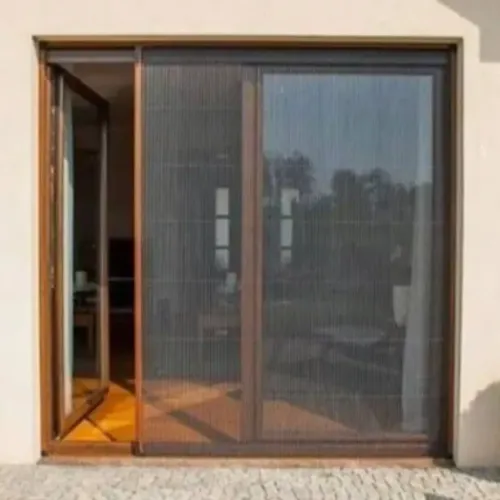
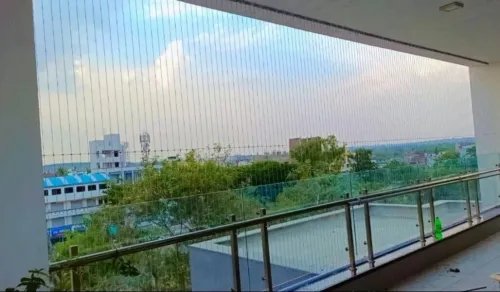
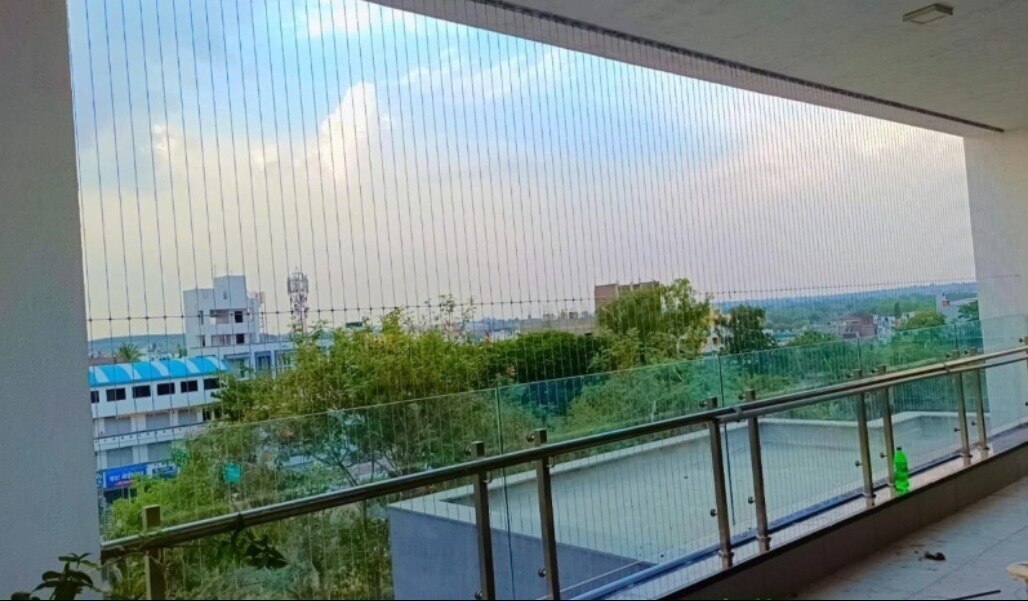
Certified child fall-protection nets, balcony safety nets, window guards and temporary construction safety netting serve different purposes. Invisible safety grills use cables rather than continuous mesh. Mosquito screens and magnetic insect meshes are not child barriers because their frames or attachments can be pushed out.
Choose bird netting when the risk is access to an opening; choose a verified fall-arrest system when the risk is a fall.
Which balcony and building openings need a Pune society site assessment?
Approve a bird net only after the committee and installer inspect every opening, not just the main balcony. For bird netting child safety in a Pune apartment, record the balcony’s width, depth and height, plus parapet and railing heights. Photograph each elevation before drawing the proposed net boundary.
| Area | Record during assessment | Check for access or obstruction |
|---|---|---|
| Balcony | Slab edges, side returns, drainage outlets, AC units and brackets, pipes, external ledges | Perimeter gaps, blocked drainage and reachable anchors |
| Windows and utility areas | Window openings, ducts, service platforms and storage spaces | Unprotected sides, hooks, cables and maintenance access |
| Terrace and shared areas | Terrace edges, adjacent balconies and shared shafts | A child reaching an open side from a neighbouring balcony |
| Emergency routes | Fire-escape paths, rescue openings and firefighting equipment | Evacuation, rescue and equipment operation without cutting the net |
| Maintenance points | Doors, cleaning routes, drain outlets and removable sections | Safe opening, cleaning, repair and exit procedures |
Mark loose lower edges, corner gaps, sagging mesh, climbable horizontal ropes, exposed hooks, sharp cable ends and reachable hardware. Check whether furniture, planters, storage boxes or AC platforms form footholds.
The written assessment must state how residents will open, clean, repair and exit the protected area. If a balcony door or window opens from inside, review its latch and restrictor separately; a net does not control that opening. A tight centre with a loose AC-pipe edge is still an unsafe installation.
What fitting measurements should the society put in writing?
Put the measurements and limits in the society’s work order, not in a verbal promise. State the maximum permitted opening in the installed mesh, including corners and junctions with walls, slab edges, parapets, doors, pipes and AC brackets.
The 100 mm (4 in) sphere benchmark used in guard-safety guidance is a useful screening check, not proof of Indian legal compliance or child-safety certification.
Require the specification to record:
- Continuous top, bottom and side closure, with a separate edge-gap limit for every perimeter junction.
- Anchor spacing, anchor type, corrosion-resistant fixing material and the support substrate at each point: reinforced concrete, brick, plaster, cladding or railing.
- The permitted net tension and minimum separation from parapets, railings, pipes and other footholds.
- The manufacturer’s design value or a named test method for anchor spacing, tension and foothold separation. No universal figure is safe for every balcony.
- A sample installation on the actual substrate before society-wide work begins.
- The mesh-opening limit, edge-gap limit, maintenance responsibility and inspection method in writing.
- A handover check confirming closed corners, secure fixings, clear drainage and unobstructed doors or access routes.
Do not approve a net because it looks tight. Excessive tension can pull weak fixings from plaster, brick or a railing; slack mesh and perimeter gaps create access routes. These measurements make the bird netting benefits for children in Pune inspectable rather than assumed.
How should Pune societies compare materials and inspect the net?
Pune’s heat, dust and monsoon exposure make the written specification more important than the label “bird net.” Require the mesh polymer, UV-protection provision, fixing material and inspection method; confirm which options the chosen installer actually supplies.
| Material | UV, wear and moisture | Visibility, dust and upkeep | Corrosion and replacement |
|---|---|---|---|
| Nylon | Needs stated UV stabilisation; abrasion can weaken strands; does not rot like natural fibre | Usually fine-looking but can retain dust; wash with water and mild detergent | Fixings can corrode; replacement is difficult once brittle |
| Polyethylene | Choose UV-stabilised grade; resists rot and routine moisture | Light and visible; dust settles on mesh; hose-clean without harsh chemicals | Polymer replacement means removing perimeter ties or fixings |
| Polyester | Good abrasion resistance; require the supplier’s UV specification | Often less visually intrusive; inspect before washing | Replacement depends on knots, tension and edge access |
| Stainless-steel cable support | Cable is support, not a child fall-arrest net; inspect rubbing points | Slim profile but dust collects on fittings and cable crossings | Specify stainless grade and compatible fixings; corrosion or pulled anchors complicate replacement |
| Other materials | Get the exact polymer, coating and test information | Do not assume “invisible” means low maintenance | Confirm availability and replacement parts in writing |
Inspect at handover, after monsoon exposure, after painting or facade work, after AC or plumbing maintenance, and immediately after a child pulls, climbs or hangs on the net. Check for brittleness, fading, frayed strands, broken knots, loose lower edges, enlarged openings, sagging, corrosion, sharp ends and pulled-out anchors.
There is no universal replacement interval; material, exposure, tension and fixing condition decide it. Assign a written maintenance owner and require a procedure for temporary removal and secure refitting. Bird netting for society balconies in Pune needs that record, not a one-time installation invoice.
How should a society approve an installation without creating new risks?
Approval should use one drawing and one written specification for every installer. Require a sample fixing on the actual substrate, then record the mesh material, UV-stabilisation method, maximum opening and edge-gap limits, continuous edge-closure method, anchor type, corrosion resistance and maintenance instructions.
Include Global Pest Control in the comparison, but judge the submitted system and site-specific handover inspection—not a service claim or the phrase “invisible grill.”
Invisible safety grills and bird netting are separate choices:
| Option | What it does | Main risk or limit |
|---|---|---|
| Invisible safety grill | Uses horizontal cables with low visual obstruction | Cables can be climbable and openings may be too wide for child protection |
| Bird netting | Uses continuous mesh to restrict access and exclude birds | It fails if perimeter gaps remain or the structure cannot carry the fixing |
Document how balcony doors, sliding doors and windows are controlled. A net across a balcony does not stop a child opening the door and reaching the barrier.
Reject any layout crossing a fire-escape route, rescue opening or firefighting-equipment access point. Define an evacuation path that needs neither cutting the net nor finding a tool elsewhere.
At handover, check that the child safe bird netting society in Pune has:
- Closed top, bottom, side and corner gaps, including around pipes and AC brackets
- Clear access to adjacent balconies, shared shafts, drainage and maintenance points
- An acceptable facade appearance and a named complaint contact
- A scheduled reinspection after monsoon exposure, facade work or repairs
Related product
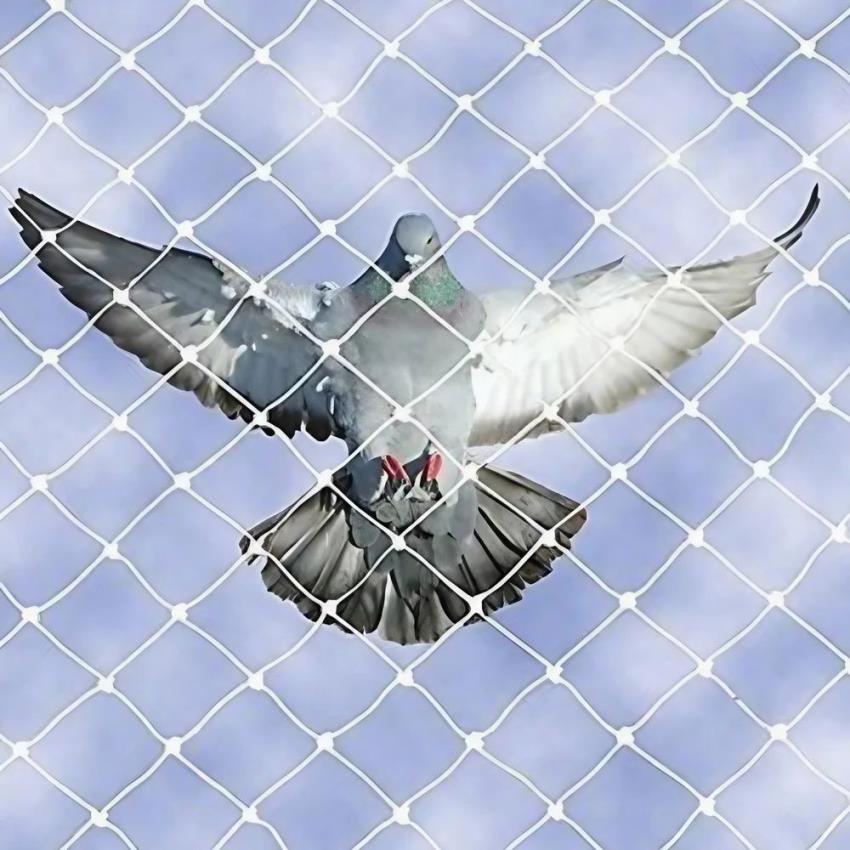 | Bird Netting Global Pest Control Bird Netting Services has more than 6 years of experience in Bird Netting Services. View product → |
Frequently asked questions
What does bird netting protect children from, and what can it not do?
A correctly fitted net can block access to balcony edges, parapets, service ledges, ducts and open windows. It is an access-control barrier, not certified fall-arrest equipment and must not be treated as a climbing surface or rescue system.
Which openings need a Pune apartment society site assessment?
Assess every opening a child could reach or climb toward, including balconies, windows, service ledges, duct openings and gaps around balcony structures. Inspect each flat type and shared area because layouts and anchor surfaces can differ.
What fitting measurements should a society put in writing?
Record each opening's width and height, net boundaries, anchor-point locations, edge gaps, overlaps, fixing type and access requirements. Attach marked photographs or drawings so installers and inspectors work from the same scope.
How should a society approve and inspect bird-netting installation?
Compare the proposed net, cable, anchors, fasteners and maintenance plan, then inspect tension, continuous coverage, edge gaps, fixings and emergency access before acceptance. Do not approve work that creates sharp projections, loose sections or blocked escape routes.